
Spa Management Software in Thailand: What to Look For (2026 Owner's Guide)
If you run a massage shop or spa in Thailand — or you're about to open one — spa management software is one of those decisions that quietly shapes your daily life for years. The right system means you can check bookings, therapist queues and today's sales from your phone at home. The wrong one means you, or someone you pay, re-typing numbers into spreadsheets every night. This guide is written from the perspective of the team behind ThaiHand POS, which runs the back office for more than 800 massage and spa shops across Thailand. Whatever system you end up choosing, these are the things worth checking before you commit.
Why a generic retail POS falls short in a massage shop
Most point-of-sale systems are built for selling items: scan, pay, done. A massage shop sells something different — a person's time and a physical space, at the same time. Every booking has to answer several questions at once: which therapist takes this guest, for how many minutes, in which room or on which bed, when will both be free again, and how much does the therapist earn from this job?
A retail POS can ring up the payment, but it can't manage a therapist queue, prevent double-booked rooms, or calculate therapist pay per job. So shops that start with a generic system usually end up running a paper notebook or a LINE group alongside it — and the two never quite agree at closing time. Spa management software exists to make those questions answerable in one place.
The 8 features spa management software must have
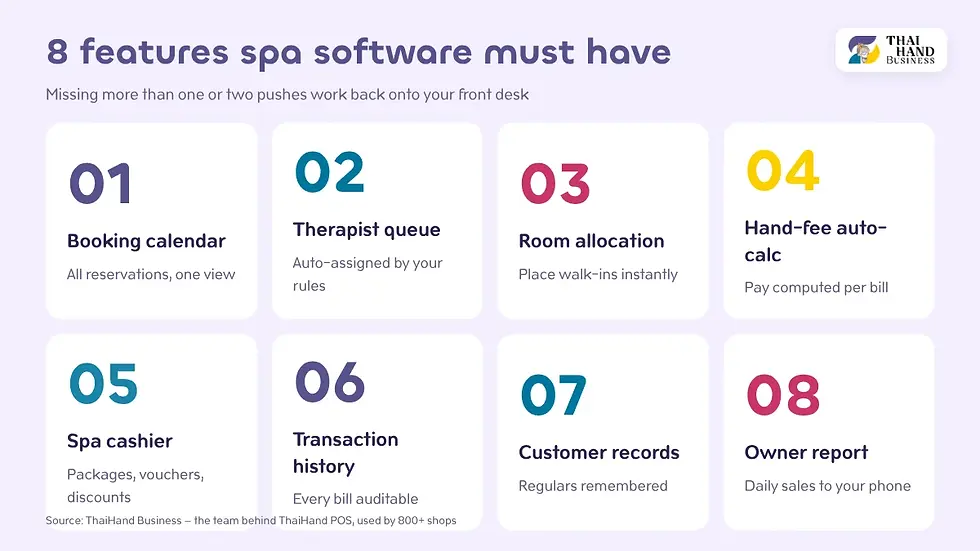
After years of watching what shop owners actually use every day, this is the core checklist. A system missing more than one or two of these will push work back onto your front desk.
Booking calendar. Every reservation visible in one view, by therapist and time, so double bookings simply can't happen.
Automatic therapist queue. The system assigns jobs by your shop's own rules — arrival order or rotation — which removes the single biggest source of staff arguments.
Room and bed allocation. Know which rooms are free and which are about to finish, so walk-ins can be placed instantly.
Automatic hand-fee calculation. Therapist pay and request fees calculated on every bill, not totted up by hand at the end of the night.
A cashier that understands spa pricing. Multi-hour menus, packages, courses, gift vouchers and discounts.
Transaction history. Every past bill auditable: who sold what, when, to whom.
Customer records (CRM). Regulars remembered, along with their preferred therapist and visit history.
A daily sales report sent to the owner. You should see today's numbers on your phone without calling the shop.
If you serve foreign tourists, add a ninth check: does the system connect to an online booking channel? ThaiHand POS, for example, integrates with the ThaiHand Massage consumer app, where more than 600 spas take direct bookings from customers.
The Thai wrinkle: hand fees and therapist queues
If you're coming from another country or another industry, the one concept that surprises new owners most is the hand fee (kha meu, ค่ามือ) — the per-job payment a therapist earns on top of, or instead of, a salary. As a teaching example from ThaiHand's spa-opening course: a shop might pay a therapist ฿120 per hour for Thai massage and ฿150 per hour for aroma oil massage, while another shop pays a ฿10,000 monthly salary plus ฿100 per hour worked, and yet another splits revenue 50/50. Every shop negotiates its own structure, and on top of that come request fees when a customer asks for a specific therapist.
Why does this matter for software? Because hand fees are calculated per job, per therapist, per menu, every single day — and therapists keep careful count. A system that calculates pay automatically on every bill, and lets therapists check their own numbers, prevents most of the disputes that make good therapists leave. When you evaluate any spa management software for the Thai market, ask the vendor to demonstrate your exact pay structure. If it can't model hand fees and request fees, it wasn't built for this market.
Owner freedom: the real return on a management system

Ask owners who've used a proper system for a year what changed, and the answer is rarely "faster checkout." It's that they stopped being chained to the front desk. With cloud-based spa management software, the shop's bookings, queue and cash position are visible from anywhere, and the daily sales summary arrives on the owner's LINE in the evening.
That's what makes a second branch — or simply a holiday — possible.
That freedom has a second, less obvious benefit: records. When every booking and bill goes through one system, you have transaction history you can audit, real numbers for your accountant, and evidence of how the business actually performs — which matters if you ever apply for financing or sell the shop. In 2568 (2025), shops running on ThaiHand POS processed more than ฿1.2 billion in transactions through the system; owners of those shops can answer "how is the business doing?" with data, not a feeling.
What it actually costs
Prices in this market range widely, so here is the one concrete number we can speak for: ThaiHand POS costs ฿10,000 per year (excluding VAT), and paying annually gets you 14 months of service, with installation and staff training included. That works out to roughly ฿700–฿800 a month — in most shops, less than the revenue of a single 60-minute aroma session, which has a median price of ฿1,200 across Thailand on ThaiHand as of late 2026.
Whatever system you consider, make sure the quote includes three things: installation, training for your front-desk staff and therapists, and ongoing support in a language your team actually speaks. A cheap licence with no training often costs more in the first month of confusion than a complete package does in a year. You can see the full feature list on the ThaiHand spa management system page.
How to evaluate a system before you commit

A practical four-step test that takes less than a week:
Demo with your real menu. Give the vendor your actual price list, your queue rules and your pay structure, and watch them set it up. Vague answers here become daily problems later.
Simulate your busiest day. Walk through a Saturday evening: three walk-ins, one booking by phone, one customer requesting a specific therapist, one room out of service. Does the screen stay understandable?
Check the owner's view. Open the owner app or report. Can you see today's sales, each therapist's jobs and hand fees, and the booking calendar without calling the shop?
Talk to a real customer of theirs. Ask another shop owner who uses the system what support is like three months in — response time matters more than feature lists.
One more practical point for foreign owners: make sure staff-facing screens work in Thai and owner-facing reports work in a language you read comfortably. Your receptionist and your therapists will use this system far more hours a day than you will.
FAQ
What does spa management software cost in Thailand? As a reference point, ThaiHand POS is ฿10,000 per year excluding VAT, with 14 months of service on annual payment and installation and training included. Always confirm what the quoted price includes — training and support are where cheap offers usually cut corners.
Can I run a small shop on spreadsheets instead? For a very small shop — one to three therapists, walk-in only — a notebook or spreadsheet can work. The switching point usually comes when you take bookings from several channels or pay hand fees to more than three or four therapists; past that point, manual tracking starts costing real money in errors and front-desk time.
Does spa management software handle Thai hand fees and request fees? Purpose-built systems for the Thai market do — ThaiHand POS calculates hand fees and request fees automatically on every bill. Generic international salon software often doesn't, so test this specifically with your own pay structure before signing anything.
Can the software help me get more bookings, not just manage them? Some systems connect to consumer booking channels. ThaiHand POS integrates with the ThaiHand Massage app, where 600+ spas receive direct bookings, so online reservations drop straight into the same calendar and therapist queue as walk-ins.
I'm a foreigner opening a shop — is software the first thing to sort out? No — your company structure and the health-establishment licence come first (talk to a qualified accountant and the Department of Health Service Support, สบส., for specifics). But choose your software before opening day, because the queue rules, menus and pay structure you set up in it force exactly the operational decisions you want settled before your first customer walks in.
This guide reflects the experience of the ThaiHand Business team, which supports 800+ massage and spa shops in Thailand. Hand-fee figures are teaching examples from ThaiHand's spa-opening course (Course 101), not market rates; median prices are from shops bookable on ThaiHand as of 27 October 2026. For licensing and tax specifics, consult an accountant or สบส. directly.
Ready to see how your shop would run on a proper system? Talk to the ThaiHand Business team on LINE @thaihandbusiness — a free consultation, no obligation — or read more about ThaiHand POS.


ความคิดเห็น